
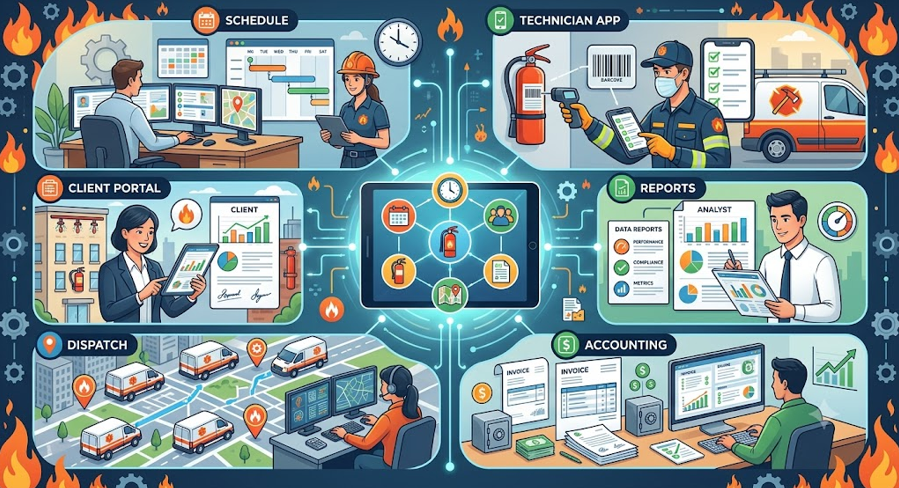
Running a fire protection company means juggling far more than inspections and repairs. There’s scheduling technicians across dozens of sites, tracking which extinguishers or sprinkler heads are due for testing, chasing paperwork, and making sure invoices actually go out once a job is done. When all of this lives across paper forms, spreadsheets, and someone’s memory, small businesses hit a ceiling fast. This is exactly the gap that job management software is built to close — and for fire protection companies specifically, the right platform can be the difference between a business that’s constantly firefighting its own operations and one that scales smoothly.
What Is Job Management Software?
Before looking at the benefits, it helps to answer a basic question: what is job management software, exactly? At its core, it’s a platform that lets a service business plan, schedule, track, and complete jobs from a single system — instead of splitting that work across a whiteboard, a spreadsheet, a paper inspection form, and a separate invoicing tool.
For a general field service business, that might mean managing appointments and technician calendars. For a fire protection company, it means something more specific: coordinating recurring inspections, tracking compliance deadlines, logging asset history for every fire extinguisher and alarm panel, and connecting all of that field activity to billing. In other words, job management software for this industry isn’t generic — it’s shaped around the compliance and asset-tracking demands that fire and life safety work requires.
Why Fire Protection Companies Need Purpose-Built Software
Plenty of businesses could technically get by with a basic calendar app or a shared spreadsheet. Fire protection companies generally can’t, for a few reasons:
- Recurring, code-driven schedules. Sprinklers, alarms, and extinguishers all need testing on set cycles — monthly, quarterly, annually — and missing one isn’t just an inconvenience, it’s a compliance failure.
- Asset-level detail. A single client site might have dozens of individually tracked devices, each with its own inspection history, deficiency notes, and next-due date.
- Multi-site complexity. Technicians often serve many properties in a day, each requiring different paperwork, different access requirements, and different reporting formats.
- Documentation obligations. Fire marshals, insurers, and property managers all expect clean, retrievable records — something paper files rarely deliver reliably.
This is why fire safety service management software — built specifically around these demands — tends to outperform generic scheduling tools for fire protection businesses, even ones that are only a few technicians strong.
Core Benefits of Job Management Software for Fire Protection Companies
1. Better Visibility Across the Whole Business
One of the most immediate benefits owners notice is visibility. Instead of guessing which jobs are done, which are overdue, and which technician is free, everything sits in one dashboard. Office staff can see job status in real time, spot bottlenecks before they become client complaints, and reassign work on the fly if a technician calls in sick or a job runs long.
This visibility also extends to compliance tracking. With fire safety field service software, upcoming inspection deadlines are visible weeks in advance rather than discovered the week they’re already overdue.
2. Streamlined Communication Between Office and Field
Miscommunication is one of the most common — and most avoidable — sources of wasted time in fire protection businesses. Paper-based systems are especially prone to this: a technician updates a job in the field, but the office doesn’t find out until the paperwork is physically returned, sometimes days later.
Job management software solves this by keeping office and field teams working off the same live data. Technicians can log completed work, flag deficiencies, and request follow-up jobs directly from a mobile device, and the office sees those updates instantly. Technician skills and availability can also be tracked in the system, so the right person is matched to the right job — important in an industry where certifications and specialized training vary by technician.
3. Higher Technician Productivity
Automation is where job management software earns its keep for busy fire protection teams. Rather than technicians manually working out their own routes or office staff manually assigning jobs one by one, scheduling automation groups nearby jobs together, matches jobs to qualified technicians, and reduces the downtime between appointments.
For companies running fire protection field service software across a large technician roster or a wide geographic footprint, this kind of automated scheduling often makes the difference between a team that’s stretched thin and one that’s operating efficiently even as job volume grows.
4. Reliable Asset and Compliance Management
Fire protection work is fundamentally about assets — extinguishers, sprinkler heads, alarm panels, suppression systems — each with its own inspection history and compliance clock. Paper inspection sheets get damaged, lost, or filled out inconsistently. A cloud-based system changes that entirely.
With asset management built into the platform, technicians can pull up a device’s full history on-site, log a new inspection against it, flag a defect, and schedule the next required test — all in the same workflow. Office staff and clients both get a clean, auditable record for every device, rather than a folder of paper that may or may not be complete.
5. Fewer Missed Jobs, Fewer Missed Invoices
There’s a quieter benefit that often gets overlooked: revenue leakage. When job completion and invoicing live in separate systems, it’s easy for finished work to sit unbilled for weeks — or fall through the cracks entirely. Connecting job completion directly to invoicing closes that gap, so completed inspections translate into revenue without a manual handoff.
6. Stronger Customer Relationships
Clients — particularly property managers and facility owners — care about two things: their sites staying compliant, and clear communication when something needs attention. Job management software supports both. Automated reminders keep clients informed about upcoming inspections, digital reports can be sent immediately after a job is completed, and a documented history builds trust over time. For an alarm company field service management operation juggling many recurring client contracts, this kind of consistency is often what separates companies that retain clients long-term from those that lose them to competitors.
What to Look for When Choosing a Platform
Not all job management platforms are created equal, and fire protection companies have specific needs that generic field service tools don’t always address. When evaluating options, it’s worth checking for:
- Industry-specific checklists covering sprinklers, alarms, extinguishers, and suppression systems — not just generic job templates.
- Mobile-first field tools, since inspection and testing data is captured on-site, not in an office.
- Automated scheduling and reminders tied to compliance deadlines, not just general appointment booking.
- Asset history tracking at the device level, searchable by site, technician, or inspection date.
- Integrated invoicing, so completed work automatically feeds into billing.
- Scalability, since a system that works for five technicians should also support fifty without needing to be replaced.
Companies weighing their options here are often really asking a bigger question: what’s the best erp system for fire life safety business operations, since job management is usually just one module of a broader system that also handles accounting, asset tracking, and reporting. The platforms that perform best in this space tend to be the ones built specifically for fire and life safety work, rather than general trades software adapted after the fact.
The Bigger Picture
It’s easy to think of job management software as simply a scheduling upgrade, but for fire protection companies its real value runs deeper. It’s the connective tissue between compliance and operations — making sure recurring inspections happen on time, technicians spend their day doing billable work instead of paperwork, deficiencies get tracked through to resolution, and completed jobs turn into paid invoices without falling through the cracks.
For a growing fire protection business, that connective tissue matters more with every new client and every new technician added to the team. A company running on spreadsheets and paper forms might manage fine with a handful of sites. But the moment growth accelerates, those same manual processes become the bottleneck holding the business back.
Final Thoughts
The businesses getting the most out of job management software aren’t necessarily the ones with the flashiest technology — they’re the ones that picked a platform built around how fire protection work actually happens: recurring, compliance-driven, asset-heavy, and spread across many sites and technicians. Done right, job management software doesn’t just save time. It gives owners real visibility into their business, keeps clients compliant and confident, and frees technicians and office staff alike to focus on the work that actually grows the company.