
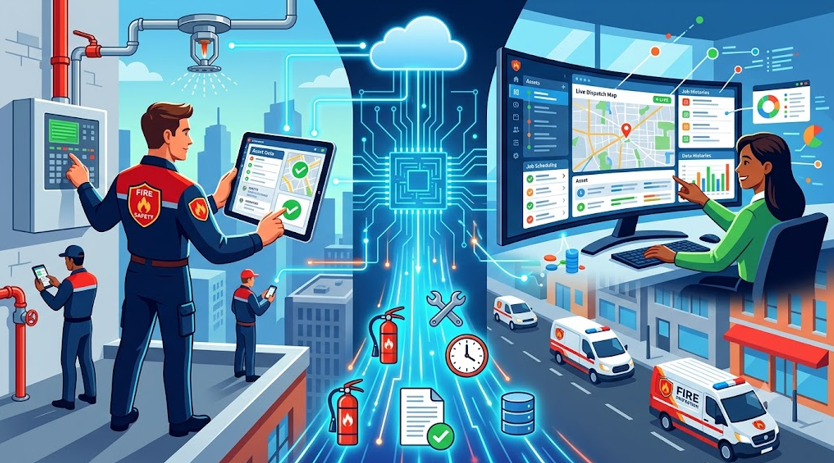
A few years ago, a fire protection technician’s day looked a lot like this: a stack of paper inspection forms, a clipboard, a pen that inevitably ran out of ink halfway through the route, and a drive back to the office to hand everything over so someone else could type it up. Today, that same technician is far more likely to carry a phone or tablet loaded with a mobile app that captures the inspection, syncs it to the office instantly, and flags any deficiency before they’ve even left the site. This shift isn’t cosmetic — it’s fundamentally changing how fire protection businesses operate, and it’s happening fast.
The Shift From Paper to Mobile in Fire Protection
Fire protection work has always been field-heavy. Sprinkler testing, alarm inspections, extinguisher checks, and suppression system maintenance all happen on-site, often across dozens of properties in a single week. For a long time, the tools supporting that work lagged far behind the complexity of the job itself. Paper checklists were slow, easy to lose, and created a lag between when work happened and when the office actually knew about it.
Mobile apps closed that gap. Much like broader field service industries, where more than 80% of technicians now consider mobile apps essential to doing their jobs efficiently, fire protection has followed the same trajectory — arguably with even higher stakes, since missed documentation here isn’t just an efficiency issue, it’s a compliance and safety one.
What Mobile Field Service Apps Actually Do for Fire Protection Teams
At their core, mobile field service apps give technicians a pocket-sized version of everything they used to need an office desk for. For fire protection specifically, that typically includes:
- Digital inspection forms built around NFPA and local code requirements, replacing generic paper checklists.
- Barcode or QR scanning to instantly pull up a device’s history — extinguisher, sprinkler head, alarm panel — right at the point of inspection.
- Photo capture and annotation, so a deficiency isn’t just noted in text but documented visually.
- Offline functionality, since basements, mechanical rooms, and rural sites often have poor or no signal.
- Real-time sync, pushing completed work back to the office the moment connectivity returns.
- Automated scheduling and routing, so technicians know where to go next without waiting on a phone call.
This combination is what’s driving the broader category of fire prevention mobile tools — apps designed not just to record what happened, but to actively help prevent missed inspections and undetected deficiencies before they become real hazards.
Why This Matters More for Fire Protection Than Most Industries
Accuracy Isn’t Optional
In most field service industries, a data entry error might mean a billing dispute. In fire protection, a missed or inaccurate inspection record can mean a device that’s actually failing gets marked as compliant. This is where mobile fsm apps data accuracy in the field becomes a genuinely safety-critical concern, not just an operational nicety. Structured digital forms — with required fields, dropdowns, and built-in validation — dramatically reduce the kind of transcription errors that paper forms are prone to.
The Office Needs to Know Immediately, Not Eventually
Fire protection businesses often manage compliance deadlines for hundreds of assets across dozens of clients. When technician updates only reach the office days later — because paperwork has to be physically returned and processed — the business is effectively operating on stale information the entire time. This is the core promise behind fsm mobile apps seamless sync with office operations: the moment a technician completes or flags something in the field, the office dashboard reflects it. Deficiencies can trigger follow-up work orders immediately, and compliance deadlines stay accurate in real time rather than catching up days later.
Documentation Has to Hold Up to Scrutiny
Fire marshals, insurers, and property managers all expect clean, retrievable proof that inspections happened on schedule and were done correctly. Mobile apps that timestamp, geotag, and photo-document every inspection create a far stronger audit trail than a signed paper form ever could — one that’s searchable and exportable rather than buried in a filing cabinet.
Parallels With Firefighter and Emergency Response Technology
It’s worth noting that the mobile transformation happening in fire protection field service mirrors a similar shift already underway on the emergency response side of the fire industry. Firefighter mobile apps and other apps for firefighters are increasingly used to access building pre-plans, hazardous materials data, and hydrant locations directly from a truck or handheld device en route to a call. Similarly, the mobile data terminal in firefighting has long served as the in-cab system connecting crews to dispatch, incident details, and mapping data in real time.
While these tools serve emergency response rather than inspection and maintenance work, they reflect the same underlying principle driving field service mobile apps in fire protection: the people doing the work in the field need real-time, accurate information at the point of action — not information that’s several steps removed and hours or days old. A fireapp built for inspection technicians and one built for a fire crew responding to an active call are solving different problems, but both exist because mobile technology finally makes real-time field data possible in ways paper and radio never could.
Core Benefits of Mobile Apps for Fire Protection Field Service
1. Faster Job Completion
Technicians spend less time filling out forms and more time actually inspecting equipment. Pre-built digital checklists, barcode scanning, and auto-filled asset history all shave minutes off every stop — minutes that add up across a full day of appointments.
2. Fewer Errors and Omissions
Digital forms with required fields and built-in code logic prevent technicians from accidentally skipping a required test point — something that happens far more easily on paper, especially during a long, repetitive route.
3. Real-Time Visibility for Managers
Office staff and managers can see, at a glance, which jobs are complete, which are in progress, and which have flagged issues — without waiting for end-of-day paperwork. This makes it far easier to reassign work, respond to urgent client requests, or catch a problem before it snowballs.
4. Stronger Compliance Records
Every inspection captured through a mobile app comes with a timestamp, technician signature, and often GPS location — creating a defensible, audit-ready record automatically, rather than something that has to be reconstructed after the fact.
5. Better Customer Experience
Clients increasingly expect the same responsiveness from service providers that they get everywhere else. Being able to send a digital inspection report immediately after a technician leaves the site — rather than days later — signals professionalism and builds trust, particularly with property managers overseeing multiple locations.
6. Resilience in Low-Connectivity Environments
Fire protection work regularly takes technicians into basements, mechanical rooms, and remote sites with poor signal. Offline-capable apps that store data locally and sync automatically once connectivity returns ensure that a bad signal doesn’t mean lost work or a return trip.
Challenges Fire Protection Businesses Should Plan For
Adopting mobile field service technology isn’t automatically smooth, and it’s worth being realistic about the common friction points:
- Technician adoption — Some experienced technicians are used to paper and need training and buy-in, not just a new app dropped on their phone.
- Connectivity gaps — Not every mobile app handles offline work gracefully; this should be tested before full rollout, not assumed.
- Integration with existing systems — A mobile app that doesn’t sync cleanly with scheduling, accounting, or asset management tools just creates a new data silo instead of solving the old one.
- Device management — Whether technicians use company-issued devices or personal phones affects security, consistency, and support requirements.
Businesses that plan for these upfront tend to see a much smoother transition than those that treat the rollout as a simple app download.
Where This Is Heading
Mobile apps are increasingly just the entry point into a broader shift in field service technology. Predictive scheduling, automated routing, and deeper integration between inspection data and asset history are becoming standard expectations rather than premium features. As more fire protection businesses adopt these tools, the competitive gap between companies still running on paper and those operating on real-time mobile data is only going to widen — not just in efficiency, but in the quality and reliability of the compliance record they can offer clients.
Final Thoughts
The move from paper to mobile in fire protection field service isn’t just about convenience — it’s about closing the gap between when work happens and when it’s known, documented, and acted on. For an industry where a missed inspection carries real safety consequences, that gap matters more than in almost any other field service context. Businesses that invest in the right mobile tools aren’t just making their technicians’ days easier; they’re building a more accurate, more responsive, and ultimately safer operation — one inspection at a time.